Tuesday, June 3, 2014

Batman: The Animated Series: My Top Five Episodes


Before being revamped and retitled The New Batman Adventures, the production run of Batman: The Animated Series contained 85 episodes. In revisiting B:TAS, I wanted to look at five of my favorite episodes of the series.  Not what I think are the five best (mainly because I’ve talked about a couple of those), but five of the ones I enjoy the most.  So, in no particular order, here they are:


#5- What Is Reality?


After making his first appearance in If You’re So Smart, Why Aren’t You Rich?, The Riddler returns to wreak havoc on Gotham.  As part of his new plot, The Riddler “abducts” Commissioner Gordon by linking him to a virtual reality program (super 90’s stuff here).  Batman and Robin must link themselves to the program as well in order to save Gordon.  The Dynamic Duo encounters a series of The Riddler’s trademark riddles in this virtual reality, ultimately ending with Batman riding a Pegasus and fighting a giant golden Minotaur.  I couldn’t make this up if I wanted to, but it’s this level of absurdity that oftentimes drew me toward this show in my childhood.


 #4- The Strange Secret of Bruce Wayne


When Professor Hugo Strange learns the true identity of Batman, he attempts to sell the information to the highest bidder.  Which makes for a tight situation for The Dark Knight when those bidders are The Joker, Two-Face, and The Penguin.  Batman is able to turn the villains against Strange using the professor’s own mind-reading device. When Strange attempts to reveal Batman’s identity as Bruce Wayne, the villains dismiss his claim, partly due to seeing Batman and Bruce Wayne in the same place (in reality, it was Robin disguised as Bruce using a mask and stilts).

The Joker, Two-Face, and Hugo Strange
Hugo Strange is a great villain, and one of Batman’s first, but he is severely underutilized, so his inclusion in B:TAS just goes to show the depth into the Batman Mythos that this show delves.


#3- Beware the Gray Ghost


This episode is fantastic.  I’m going to have a hard time explaining exactly why, just because of the emotional response it elicits from me.  Just to give a little background, while B:TAS is my favorite interpretation of the character and Kevin Conroy (the voice actor of The Dark Knight in the series) is my Batman, the other half of my exposure to the character in those formative years was from the 1960’s Batman series.  I can remember rushing home from school in kindergarten to catch that opening theme song that defines the character for a large majority of people.  I remember my Aunt Karen recording episodes of the show for me on VHS tapes (this was before DVR, kiddos) so I could watch them over and over again.  So, as campy and cheesy as it was, I loved the 60’s Batman as much as I did The Animated Series.  The plot of this episode involves Batman trying to track down the Mad Bomber, a villain that is imitating another villain from Batman’s favorite television show as a kid, The Gray Ghost, a crimefighter-detective show.  In doing this, Batman visits the retired actor who played the Gray Ghost, Simon Trent.  Here’s the tie-in: The voice actor who plays Gray Ghost/Simon Trent…


Adam West, Batman of the 60’s television show.  Wanting nothing to do with the case, as he is suffering from depression, Trent turns Batman away.  When Batman finally encounters the villain, he is overwhelmed by the Mad Bomber and his remote control planes, but is saved by Simon Trent in full Gray Ghost costume.  The two team up to defeat the villain and Trent is hailed as a hero with his career restarted by the release of The Gray Ghost on video and broadcast television and he is offered a part in a film. While signing autographs at a convention, he is approached by Bruce Wayne, who says that he the Gray Ghost was his hero... and he still is. Having heard these same words from Batman, Trent seems to suspect who Bruce Wayne really is, which he acknowledges with a smile.  I love the “full circle” sense this episode gives by having Adam West guest star.  Having West voice the character was so important to the creators of B:TAS that they have stated that they would not have done the episode without West.  The episode brought new found respect for West among Batman fans of the time who had turned their back on the 60’s interpretation of the character.  I, on the other hand, loved every minute of being able to see my childhood hero team with his childhood hero.


#2- The Demon's Quest


The 57th and 58th episodes of the series were a two-part story featuring the first full appearance of my all-time favorite Batman villain: Ra’s al Ghul.  His first appearance was a handful of episodes earlier in Off Balance, where Batman meets Ra’s daughter, Talia.  In that episode, Ra’s appears at the end in a brief cameo.  In this episode, however, Ra’s comes to Batman (breaking into the Batcave in the process) and asks for his help in locating Talia, who had been abducted several nights prior.  Ra’s reveals that the captors have custody of Robin as well, so Batman (or “Detective” as Ra’s calls him) agrees to help.  Highlights of the first episode include, Batman’s several run-ins with Ra’s bodyguard, Ubu, Batman hand-to-hand fighting a panther, and the reveal that the abductor of Talia and Robin was Ra’s all along.  Ra’s states that he did so to test Batman’s worth as a successor to himself and, by extension, as a mate for Talia.  When Batman refuses, Ra’s declares them enemies of one another, but collapses following that.  Talia says that Ra’s must be taken to the Lazarus Pit (a mysterious chemical pit that has kept Ra’s alive for six hundred years).  At the Lazarus Pit, Ra’s is submerged where he is rejuvenated and emerges in a crazed state (as is a side effect of the pit).  The second half of the story details Batman and Robin attempting to stop Ra’s plan of detonating bombs in Lazarus pits around the world causing them to overflow, covering the world in chemicals, killing a third of the Earth’s population and restoring most of the world's ecosystems.  The climax of the episode features (obviously Batman stopping the bombs, but also) a sword fight between Ra’s and The Dark Knight reminiscent of Ra’s first comic appearance in the 1970’s.
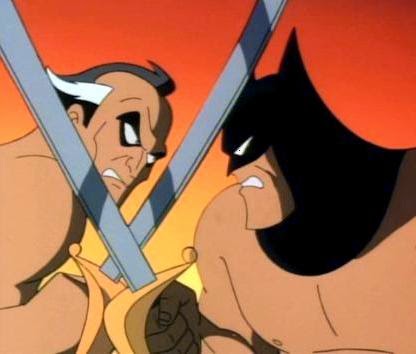
The Demon vs. The Detective

The appeal of this story to me is the involvement of Ra’s al Ghul who is not only my favorite villain, but also one of the more interesting of Batman’s villains in that his goal is not to gain money (he has more than almost anyone, including Batman), to learn Batman’s identity (he knows; doesn’t care), or to kill Batman (not necessarily, anyway), but is to rid Earth of those that do it harm.  He’s a true “eco terrorist” and that is an extreme departure from other Bat-villains (sans Poison Ivy).  But, in addition to all of that, I love the femme fatale nature of Talia al Ghul.  The story of her (almost, but not really) unrequited love for Batman is intriguing.  It’s almost Romeo & Juliet, in a way.  Plus, it allows for moments like this:

Talia and Batman share a kiss


Honorable Mention- Night of the Ninja & Day of the Samurai

I’m cheating a little bit and including two honorable mentions in my Top Five.  Night of the Ninja and Day of the Samurai are two episodes that, while they don’t occur back-to-back, are a continuation of the same story.  In the first episode, Batman encounters a ninja in Gotham City who is attempting to kill Bruce Wayne.  Batman learns that the ninja is Kyodai Ken, a fellow student from the dojo in Japan where Bruce was trained.  Seeking revenge for being kicked out of the dojo, Kyodai looks to fight Bruce Wayne, but gets Batman instead.

Kyodai vs. Batman

Airing almost six months later, the second appearance of Kyodai Ken sees the ninja abduct the star pupil of Yoro Sensei, the man who trained both Kyodai and Bruce Wayne.  Holding the girl for ransom, Kyodai looks to learn the technique of Kiba no Hoko or "The Way of the Fang", an ancient fighting style that has been kept secret by Yoro’s family for centuries due to it containing a maneuver that can kill a man with one touch.  After Kyodai is able to learn the location of the scrolls that detail Kiba no Hoko, he encounters Batman near an active volcano.  Batman is able to fake his death after Kyodai inflicts the fatal touch and uses the element of surprise to subdue the ninja.  When the volcano begins to erupt, Kyodai refuses help and is overcome by the lava, seemingly killing him.

Kyodai vs. Batman: Round Two

Similar to the Grey Ghost episode, I have a hard time explaining why I like these two episodes so much.  But different from that, it’s not due to some ethereal connection to concepts that I love.  Whatever the reason, these two episodes are essential to the experience of Batman: The Animated Series.


 #1- Almost Got 'Im


The number one episode on the list is so placed because it is probably the one episode I would refer any new B:TAS viewer (or new Batman fan in general) to if they were looking for a cool story featuring several villains.  Told mainly through flashbacks, the framework of the episode is a poker game in a seedy underground hangout.  During the poker game between Two-Face, Penguin, Poison Ivy, Killer Croc, and The Joker, each villain details the encounter in which they came the closest to defeating The Caped Crusader.  For Poison Ivy it was the use of poisoned pumpkins on Halloween, for Two-Face it was nearly crushing him with a giant penny (which is a popular piece of scenery in the Batcave), for Killer Croc states it was when "I threw a rock at him!", for Penguin it was poison-beaked hummingbirds and a cassowary (a really big bird).  The Joker states that his closest attempt came just the night before when he captured Batman, took over the studio of a late-night talk show, and attached Batman to a laugh-powered electric chair which would electrocute Batman the more the audience laughed. The Joker pumped the studio with laughing gas until "these people would laugh at the phone book" and had Harley Quinn read names out of the phone book to elicit more laughter from the crowd.  Batman is saved from electrocution by Catwoman, who is then herself captured by The Joker and Harley Quinn.

World's most dangerous poker game

The story jumps back to the poker game where Joker says that at the same time their game is going on, Catwoman is strapped to a conveyor belt in a cat food factory across town.  Killer Croc reveals himself to be Batman in disguise and the other gangsters occupying the room are truly Gotham City Police Officers.  With the villains in custody, Batman races to save Catwoman.  Once he does, she thanks him, begins to flirt with him, and tells him to remove his mask.  When Catwoman turns around, Batman is gone, prompting her to remark, "Hmm.  Almost got 'im".  This story has all of the things one could need:  Several villains, outlandish schemes by said villains, and Batman outsmarting them.  It has great comedy, exciting action, and makes references to about five other B:TAS episodes.  It is truly one of the best the show has to offer.


Next time I post, a character in the Batman Mythos will die…  I’m just going to leave it at that.

Thanks for reading!

-Josh


Sources: excerpts from primary source interviews; Wikipedia

Batman, related characters, and images in this blog are owned and trademarked by DC Comics, a division or Warner Bros. Entertainment, Inc.


Wednesday, May 28, 2014

Boy Wonder No More: Robin Becomes Nightwing


One of the more endearing qualities of the Batman Mythos is the concept of the Dynamic Duo.  Since the Spring of 1940, the team of Batman and Robin have been featured in comic books, television, movies, video games, etc.  Many people may not even know that there has been more than one young man to bear the mantle of the Boy Wonder (there have been several), mostly because the longest tenured and arguably most popular was the first: Dick Grayson.

 
Nightwing: Year One trade paperback cover art

Debuting in Detective Comics #38 (April, 1940), Dick remained in the pixie boots of Robin until mid-1984 when his role as leader of the group of sidekicks known as the Teen Titans and the lengths of time he was spending away from Gotham became longer and longer.  In order to step out of Batman’s shadow, Dick took on the role of Nightwing.  Dick first appeared as Nightwing in Tales of the Teen Titans #44 (July, 1984) battling his nemesis Deathstroke.

 
Tales of the New Teen Titans #44 (July, 1984)

It wasn’t until Nightwing got his own series (and 100 issues in at that) that the story of his transformation from Boy Wonder to Man Wonder was told in full.  Written by Chuck Dixon, Nightwing #101 to Nightwing #106 served as “Year One” for Dick Grayson as Nightwing.  The story begins with Robin returning to Gotham City from a mission with the Teen Titans to help Batman in a fight with Clayface.  Once back at the Batcave, Batman asks Alfred to get the Dynamic Duo a warm beverage to counter the effects of the winter weather to which they were just exposed.  Dick realized this request is just an excuse to get Alfred out of the room, which his internal monologue states might have prevented him and Batman from saying things they might regret.  After chastising him for never being around anymore, Batman fires Dick from being Robin.

 
Bruce being a total douche

Throughout the story, Dick encounters several other heroes, namely Superman who Dick turns to immediately after being fired, as Dick looks up to Superman and considers him a friend.  It is the Man of Steel himself that gives Dick the idea for the name Nightwing when telling him a story about a superhero of the same name on his native planet of Krypton.  Another hero the newly christened Nightwing teams-up with in this story is his former flame, Batgirl.  Having experienced a romance in their younger years, Dick and Batgirl have since split and Dick has been involved with Starfire of the Teen Titans more recently.  This leads to more than a few… Tension filled moments between the two.

 
Nightwing copping a feel
Lovebirds-of-Prey

Once establishing his new name and costume, he makes a visit to Arkham Asylum to see an “old friend”.

 
The Clown Prince of Crime getting dealt with

While the plot-line of the story is that of Dick’s transformation to Nightwing, it also serves to introduce the second Robin, Jason Todd.  Jason was a street-wise kid that Batman caught attempting to steal the hubcaps off the Batmobile.  Rather than turn him over to the authorities, Batman takes in Jason (who is either an orphan or has a deadbeat mobster for a father, depending on the story you’re reading) and trains him as the new Robin.  This is significant for two reasons.  First, it establishes the concept of “The Boy Wonder” as a role to be passed on, rather than being the identity of one person consistently.  Secondly, it grows the “Batman Family” by one.  Eventually, Batman’s network of allies would grow to be a formidable force and this story begins this trend.

 
Boy Wonder version 2.0

Jason is put through a gauntlet of challenges that serve as a “final test” for him to finally become Robin.  Through the course of this, he encounters Nightwing and the two team-up to complete the challenges together, effectively passing the torch from one to another.

 
A Duo of a different Dynamic

Now, this isn’t a “Batman” story, per se.  It’s about Dick Grayson (which is ironic because it’s Batman that acts like a total Richard throughout the story).  But, Dick (or Robin or Nightwing) has been around just one year shy of the amount of time that the Dark Knight has and is, in my opinion, the second most important person in the Batman Mythos.  Consequently, we’ll be seeing quite a bit more of Nightwing in the posts to come.


Thanks for reading!


-Josh


Sources: Wikipedia

Batman, related characters, and images in this blog are owned and trademarked by DC Comics, a division or Warner Bros. Entertainment, Inc.


Friday, May 23, 2014

Super BFFs: The History of Superman and Batman


They’re the two biggest, most popular superheroes in history.  They’re the two most influential people in the DC Universe.  They’re allies.  They’re oftentimes enemies.  They’re the leaders of the Justice League.  They’re the original Super Friends.  They’re Batman and Superman.

 
Artwork by Jim Lee

Originally meeting in the pages of Superman #76 (1952), the friendship of the Dark Knight and the Man of Steel has endured over the course of six decades.  In that first story, Bruce Wayne and Clark Kent have been booked as cabin mates on a cruise.  Throughout the story, they learn each other’s secret identities and team-up for the very first time.  Granted, the story is a little goofy, but it was the 50’s, so things weren’t all explosions and convoluted plot twists like they can be today.

 
Superman (vol. 1) #76

Together, Batman and Superman had been headlining a book called World’s Finest Comics since the Spring of 1941, but always appearing in separate stories, never together.  Okay, quick general comic book industry history lesson:  Comic books became super popular during World War II.  The main reason for this being that comics were a highly mobile, inexpensive form of entertainment for G.I.s stationed overseas.  When the war ended, interest waned and sales dropped.  Pretty much every comic outside of the titles starring the main three heroes of DC (Action Comics, Batman, Superman, Detective Comics, Wonder Woman, All Star Comics starring the Justice Society of America lasted until early-1951, but ended after that, and World’s Finest Comics) was cancelled due to the decline.  So, rather than having Batman and Superman in separate stories in World’s Finest Comics as a double-sized book, DC pulled a cost cutting move (and a promotional tactic) and had Batman and Superman (and more often than not Robin as well) begin appearing in regular-sized team-up stories beginning with World’s Finest Comics #71 (July 1954).

 
World's Finest Comics #142 featuring Composite Superman

The characterization of the two heroes from the early 50’s through about 1985 was that of best friends.  Chums.  Pals.  Lots of laughing, smiling, and bright, fun adventures.  By ‘85, DC Comics had come to the conclusion that quite a bit of their history had become convoluted and, in a move to simplify things, the maxi-series (as opposed to mini-series…) Crisis on Infinite Earths was launched.  Throughout the years, continuity had changed so many times- alternate earths were visited, multiple versions of characters existed, Superman used to be Superboy, but then there was a different version, etc. and so forth.  Confusing, see?  With Crisis on Infinite Earths, a cataclysmic event occurred, all the alternate earths were destroyed, history was rewritten, and various characters were given clean slates.  Batman remained relatively untouched other than de-aging the character considerably and allowing him to continue on the road away from the campiness of the Batman television show of the 60’s and more toward the Dark Knight that we know today.  Superman, on the other hand, was in bad shape.  He had gone from the Last Son of Krypton to being one of a handful of Kryptonians that survived: There was Supergirl, Superboy, Krypto the Superdog, to name a few.  In addition, Superman had come to a level of having nearly godlike powers.  So much so that writers had a hard time coming up with obstacles for him to overcome.  After Crisis on Infinite Earths, Superman’s history was “rebooted” to return him to those lone survivor roots and to de-power him quite a bit.

 
The Man of Steel #3 writing and art by John Byrne

In 1986, the series The Man of Steel, written and drawn by John Byrne, was launched.  The series served as a new origin for Superman and Clark Kent in the post-Crisis universe and by issue #3, the first encounter of Superman and Batman was ready to be retold.  This time, there were no cruise-liner shenanigans.  Rather, this story featured Superman and Batman at odds with one another (fore(post?)shadowing their confrontation from The Dark Knight Returns, a story released earlier that year, but set in the future of both men).  Superman travels to Gotham after hearing of the existence of a vigilante operating there.  Ultimately, Batman and Superman are forced to team-up to take on a villain together which doesn’t return them to the status quo of being super best buddies, but it does end with both men having a high level of respect for the other.  

 
Cover art to the collected edition of Superman/Batman

In later years, they would once again star in an ongoing series together in the same vein of the World’s Finest Comics series of the past.  This time titled Superman/Batman, the first 25 issues were written by acclaimed writer Jeph Loeb and a rotating crew of artists including two of my favorites: Ed McGuinness and Michael Turner.  Notable stories include the two icons clashing with Lex Luthor (who had been elected President of the United States), the reintroduction of Supergirl into the DC Universe, and a time travelling story featuring super-villains to the future.  Superman/Batman #26 was set to be the writing debut of Sam Loeb, Jeph’s 17-year-old son.  Tragically, Sam lost a three-year battle with cancer on June 17th, 2005.  A veritable army of comic creators who had known Sam collaborated on the issue to produce a story that served as a dual-eulogy for Sam as well as Superboy (who had recently been killed).  The total of 26 contributors (including Joss Whedon and John Cassaday (who were Marvel-exclusive creators at the time), Geoff Johns, Jim Lee, and Jeph’s longtime partner and friend Tim Sale) on the issue donated their fees and royalties the Sam Loeb College Scholarship Fund.  A back-up story written by Jeph Loeb just ten days after Sam's death depicts young Clark Kent's friendship with a boy named Sam who gets cancer. 

 
Superman/Batman #26

The Superman/Batman series ran for 87 issues (plus five annual issues) before cancellation during DC’s “New 52” reboot of their publication line.  After a hiatus, a version of the series with an inverted title, Batman/Superman was re-launched with a brand new #1 issue in June 2013 with writer Greg Pak and artist Jae Lee.  Their initial story portrays (another) first meeting of DC’s premier heroes, this time in the New 52 continuity.

 
Batman/Superman #1 by Greg Pak and Jae Lee

Despite 75 years of existence and 60+ years of friendship, Batman and Superman have never appeared together on screen (in live action, anyway).  It seems strange, but it’s true.  These two icons will, however, meet for the first time cinematically in 2016.  Batman V Superman: Dawn of Justice, slated to also include fellow Justice Leaguers Wonder Woman and Cyborg, will be a momentous occasion.  I gave my first thoughts on Ben Affleck’s Batsuit, but earlier this week, the official title (it had just been called "Man of Steel 2" or "Batman vs. Superman" to this point) and logo for the film were revealed.  There isn’t a lot to say about it, as its simplicity and minimalism speak for themselves, so I’ll just say: it’s about damn time.

 
Batman V Superman: Dawn of Justice (2016) Official Logo

I compare their friendship to that of my best friend and myself.  One is bright and optimistic; the other is dark and brooding.  One is friendly and likeable by nature; the other is… Not.  But, together, it works.  They’re the classic “good cop, bad cop”.  They’re two sides of a coin.  They’re peanut butter and chocolate.  They’re inspirational.  They’re best friends.


Thanks for reading.


-Josh

Sources: excerpts from primary source interviews; Wikipedia

Batman, related characters, and images in this blog are owned and trademarked by DC Comics, a division or Warner Bros. Entertainment, Inc.